Aux Arc, Ashes, & the Bend
How a river landing became Ozark, Arkansas—and the legends, losses, and remarkable characters that helped shape it.
THE OZARKER | HISTORY & HERITAGE
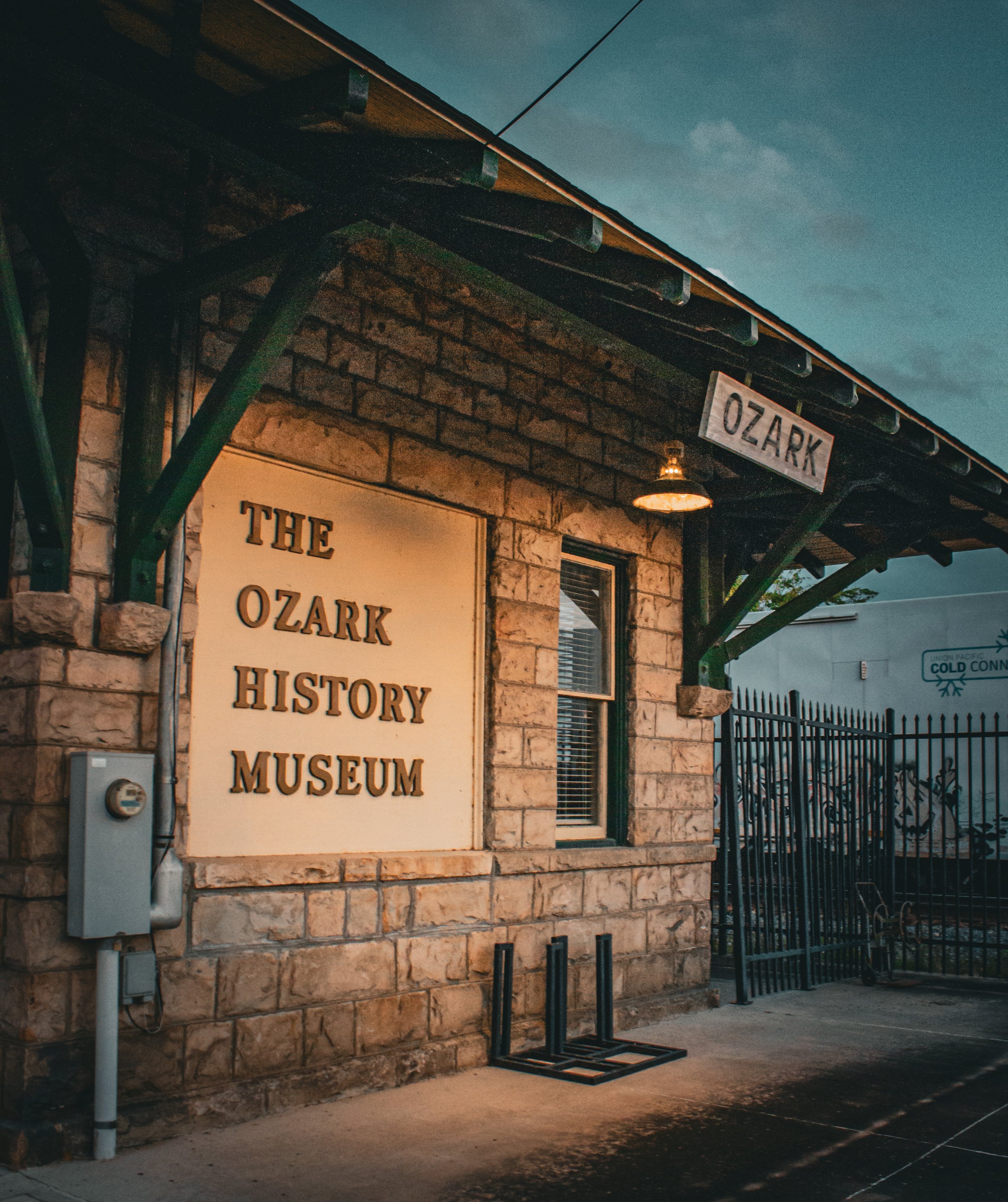
The Ozark History Museum, housed in the town's historic railroad depot. Photograph by Jess-Jo Robison.
One of the better stories told around Ozark begins with a group of French explorers, a bow, and an arrow. As the story goes, the men were traveling the Arkansas River when they decided to settle the matter of where to establish a town by firing an arrow into the wilderness. Supposedly, it landed just northeast of where our courthouse stands today.
Now, whether the French actually used archery to make their real estate decisions is another question. I haven't found a contemporary account to substantiate it, but the story has certainly survived long enough to earn its place in local lore. Besides, as we'll find out, an arrow wouldn't be the strangest thing to influence Ozark's development.
The documented history is every bit as interesting. We've got ambitious land speculators, a riverside barbecue, a courthouse turned military fortification, a railroad engineer who supposedly fell in love, and a downtown that burned more than once. For a town that can look fairly quiet from the interstate, Ozark has managed to get itself into an impressive amount of trouble over the years.
And all of it happened along a bend in the Arkansas River that mattered long before there was an Ozark, Arkansas, to put on a map.
Before Ozark, There Was the River
To understand how Ozark came to be, we ought to start with the people who were here before it had a name recognizable to us.
People have lived and traveled throughout the Arkansas River Valley for thousands of years. Archaeological evidence places human activity in what became Franklin County as far back as the end of the last Ice Age. Over the centuries, communities established settlements, developed agriculture, hunted, traded, and built their lives around the rivers and forests that still define this region.
Among those with historical ties to the area were the Osage, who used lands north of the Arkansas River as hunting territory. Cherokee communities also occupied lands along the river during the early nineteenth century, following earlier migrations westward.
The river wasn't simply something these communities lived beside. It connected them to other people and places, supplied food and other resources, and helped shape the movement of goods, traditions, and generations of families.
That relationship changed dramatically as the United States expanded westward.
The Cherokee held treaty-recognized rights to much of the surrounding region between 1819 and 1828, when another treaty forced them farther west into Indian Territory. American settlement increased as Indigenous communities were displaced, opening the way for the towns and institutions that would eventually develop throughout the valley.
The river also witnessed one of the most devastating chapters in American history.
During Indian Removal, members of the Cherokee, Chickasaw, Choctaw, Muscogee, and Seminole Nations were forced westward through Arkansas. Some removal parties traveled by water, including along the Arkansas River, where low water levels, illness, and difficult conditions added to the suffering of people already being driven from their homes.
Near Ozark, shallow water forced some groups to leave their boats and continue their journey overland. The National Park Service documents this history as part of the Trail of Tears National Historic Trail.
Today, Aux Arc Park is recognized by the National Park Service for its connection to those journeys. It's a place many people know for recreation, but its historical significance deserves just as much attention. The interpretive exhibits are worth visiting, particularly if you've never considered what the river meant to those who traveled it unwillingly.
That history is not separate from the founding of Ozark. It's part of the same story, and understanding it gives us a much clearer picture of the land on which the town was built.
Aux Arc: What's in a Name?
Here's where things get interesting, because even the name Ozark comes with a little disagreement.
Most people familiar with the town have heard the explanation that Ozark originated from the French expression Aux Arc, commonly understood in local tradition to mean "at the bend." Considering the town's position along the Arkansas River, it's a fitting explanation, and one that's become part of our identity.
The trouble is that historical linguistics doesn't always cooperate with a good local story.
Regional historians have also connected the name Ozarks to the French expression aux Arkansas, referring ultimately to the Indigenous peoples whose names contributed to the naming of Arkansas itself. The Quapaw are particularly important to that linguistic history, with the state's name developing through Indigenous languages and French interpretations of them.
Other proposed explanations have involved natural arches, trading locations, and variations in the way early travelers recorded place names.
None of this means we need to abandon the familiar Aux Arc story. It means we should understand the difference between a local tradition and a settled historical translation. Names evolve, pronunciations change, and what appears on one map might look quite different on another.
The French arrow story is another example. Some versions place the supposed explorers along the river in 1819, although I've found no contemporary documentation establishing that the incident actually occurred. It remains folklore, and there's nothing wrong with preserving folklore as long as we don't confuse it with evidence.
For anyone interested in digging deeper, the Encyclopedia of Arkansas's discussion of place names provides a good starting point.
Personally, I think the uncertainty makes the subject more interesting. There's something worthwhile about questioning a story we've heard our entire lives, especially when the research leads us somewhere we didn't expect.
Of course, the people responsible for laying out the town we recognize today were considerably easier to identify than those supposed French archers.
A Townsite, a Barbecue, & a Little Ambition
The beginnings of modern Ozark take us into the 1830s, when the Arkansas River was one of the region's most important transportation routes.
William Hail, whose surname also appears as Hale or Haile in historical accounts, and William Cureton established an early settlement near a river landing. Warehouses and commercial activity developed as goods and travelers moved along the river, giving the area the beginnings of a permanent community.
Then David Walker and Archibald Yell entered the picture.
These weren't simply two fellows looking for somewhere to put up a cabin. Walker would later serve as a justice on the Arkansas Supreme Court, and Yell would become governor of Arkansas. Both recognized the commercial opportunities developing along the river.
According to an account preserved in nineteenth-century local history, Walker and Yell saw the potential of the land between the river and surrounding hills during a hunting expedition. They purchased land from Hail, and the three men became associated with laying out and promoting the town.
They apparently had some fairly ambitious ideas about the place, too.
Advertisements promoting the settlement reportedly reached as far away as New Orleans, and one account describes a grand barbecue held along the river to attract interest in the new townsite. There was food, there were refreshments, and there was land to sell. Apparently, the fundamentals of a successful community gathering haven't changed all that much.
The same historical account includes a story about a surveyor throwing a stick onto the ground and declaring that the courthouse square, and eventually the town itself, would be laid out around that spot.
Whether the stick actually determined anything is another matter, but it makes for a fitting companion to our French arrow. Ozark seems to have accumulated quite a collection of stories about people tossing things into the wilderness and calling it city planning.
What we can document is that the settlement took shape quickly.
Ozark's founding is traditionally dated to 1836, the same year Arkansas achieved statehood. Franklin County was established from Crawford County on December 19, 1837, and named in honor of Benjamin Franklin. Ozark became the county seat.
The first post office opened July 3, 1837, with Hail briefly serving as postmaster. County business was conducted in March 1838 inside a small log schoolhouse reportedly lacking both windows and doors. A permanent courthouse was completed in 1840, giving the growing county a more suitable place to conduct its affairs.
Ozark was officially incorporated on December 17, 1850.
In roughly fifteen years, the settlement had gone from a promising river landing to an organized town with a courthouse, post office, businesses, and a place in the political life of the new state.
If you want to get a better sense of how the early town developed, spend some time around the Franklin County Courthouse at 211 W. Commercial Street. The Arkansas Historic Preservation Program's downtown walking-tour research is particularly useful for understanding what once stood around the square and how the buildings changed over time.
Just remember that much of what those early residents built wouldn't survive the next chapter.
A Town Nearly Erased
By the time the Civil War began, Ozark had developed the institutions and commercial activity expected of a growing county seat. There were homes, businesses, schools, churches, and a courthouse serving the surrounding community.
Then came the war.
Franklin County occupied a difficult position during the conflict, with Union and Confederate forces operating throughout the Arkansas River Valley. Communities endured military movements, divided loyalties, property destruction, and the instability that followed both armies.
Ozark suffered especially heavy damage.
Historical accounts describe Union troops burning much of the town's commercial district and its churches, reportedly leaving only three homes standing. The town's two-story brick school building also suffered damage.
The courthouse wasn't spared, either.
The second Franklin County Courthouse, completed in 1851, was occupied by Federal troops and modified for defensive purposes. Confederate soldiers later captured supplies left behind and burned the structure.
For a community whose identity and economy were closely tied to its county seat, losing the courthouse alongside so much of the town was a serious blow. Public buildings, business properties, and gathering places had to be rebuilt, often by families whose own circumstances had been badly affected by the war.
It's also important to remember that Ozark's Civil War history wasn't limited to military campaigns and damaged buildings. The region's economy and social structure included slavery. The 1860 census recorded 962 enslaved people in Franklin County, whose lives and labor were part of the community's development long before emancipation.
Their experiences, along with those of the families navigating wartime division and Reconstruction, belong in the historical record just as much as the names of governors, judges, and landowners.
Ozark's incorporation lapsed during the war years, according to local histories, before the community was reincorporated in 1869. Businesses gradually reopened, homes were reconstructed, and the courthouse square began reclaiming its place as the center of town.
The community survived, but much of its earliest architecture did not.
That's worth keeping in mind when walking through downtown today. The absence of buildings from Ozark's founding years isn't necessarily evidence that little existed here. Quite a lot existed here. Much of it simply didn't make it through the nineteenth century.
And just as the town was finding its footing again, another form of transportation was preparing to change its future.
The Railroad, the Romance, & the River Valley
In the early 1870s, railroad construction began making its way westward through the Arkansas River Valley. The Little Rock & Fort Smith Railroad reached Clarksville in 1873, and by 1876, the tracks had reached Ozark.
That much is documented. How the railroad allegedly came to pass through Ozark is where the story gets entertaining.
According to local lore, the original railroad route was supposed to bypass the town entirely. Fortunately for Ozark, the chief engineer supposedly fell in love with a young woman who lived here and decided to change the proposed route so the railroad would pass through her community.
Now, I haven't found enough evidence to call that version of events historical fact. We would need to identify the engineer, examine early surveys, and find contemporary records before giving romance the credit for a railroad alignment.
But I have to appreciate the story.
Most towns spend years lobbying to attract infrastructure. According to this one, Ozark may have managed it because somebody got sweet on a local girl.
Whether love had anything to do with the decision or not, the railroad's arrival was a significant development.
By 1888, four passenger trains reportedly passed through Ozark each day. Rail service connected local merchants to distant markets, encouraged commercial development, and helped establish Ozark as an important livestock-trading center in the River Valley.
Cattle and horses were major parts of the local economy, while coal mining attracted workers and investment throughout Franklin County.
The railroad also helped shape the communities surrounding Ozark. Swiss and German immigrants settled in the area, bringing agricultural knowledge, trades, and customs that became part of the region's cultural identity.
Among the most enduring results was the development of winemaking around Altus.
Families such as the Posts and Wiederkehrs established vineyards and wineries during the nineteenth century, building a wine industry supported in part by immigrant communities, railroad workers, and coal miners.
It's an interesting combination when you consider it: livestock trading, coal mining, railroad commerce, and European winemaking, all developing within a relatively small section of the Arkansas River Valley.
Today, Altus Wine Country is one of the region's defining attractions, but its roots are much older than modern tourism. The history of Altus and the development of Arkansas winemaking are worth exploring if you want to understand how those immigrant families helped shape the region.
As for the railroad romance, I'd be interested to know whether any local family records or old newspaper accounts can put names to the story. It may be nothing more than an entertaining explanation repeated over generations, but every documented discovery starts with somebody willing to look.
The Square Has Seen Some Things
By the late nineteenth and early twentieth centuries, downtown Ozark was a busy commercial center.
Businesses surrounded the courthouse square, including banks, general merchants, blacksmiths, hotels, newspaper offices, confectioneries, and entertainment establishments. An opera house served the community, local musicians performed, and the streets filled with residents conducting the business of everyday life.
The square was where people gathered for commerce, government, celebrations, and occasionally events we'd view very differently today.
Public executions were one of them.
On May 28, 1880, Thomas Edmonds was hanged in Ozark after being convicted of murder. Newspaper reporting from the period estimated that approximately 5,000 people attended. Edmonds maintained his innocence and was reportedly transported to the gallows while sitting atop his own coffin.
The Encyclopedia of Arkansas documents the Edmonds case in greater detail, including the public circumstances surrounding his execution.
Today, the idea of thousands of spectators gathering for an execution is difficult to reconcile with our understanding of justice and public entertainment. At the time, however, such events were not unheard of.
It's one of the less comfortable aspects of local history, but understanding the past requires more than collecting its pleasant stories.
The courthouse square would experience plenty of other dramatic events, although few reshaped its appearance as dramatically as fire.
In January 1904, a major blaze destroyed businesses along the north side of the square. The destruction helped prompt stronger building requirements, as local leaders considered how to reduce the likelihood of another disaster.
Unfortunately, those concerns proved justified.
On February 14, 1926, another fire devastated much of the same area.
According to research compiled by the Arkansas Historic Preservation Program, Les McPherson robbed Wakefield & Company Dry Goods and then set the building on fire to conceal the crime.
The resulting blaze spread through the commercial district, destroying nearly the entire north side of the courthouse square. Only the Arkansas Valley Bank building at the western end survived.
Businesses, newspaper offices, banks, and other commercial establishments disappeared.
It's difficult to imagine the consequences of losing that much of downtown at once, especially in an era when so much of a community's commercial and social life depended on the courthouse square.
But Ozark rebuilt again.
Many of the yellow-brick buildings along the north side of the square date to reconstruction following the 1926 fire. They're part of the streetscape people recognize today, although it's easy to overlook the circumstances that led to their construction.
And the courthouse itself wasn't finished with fire.
The building completed in 1905 had originally featured an elaborate design with towers and architectural details that gave it a grander appearance than the structure we know today.
During freezing rain on January 10, 1944, a fire gutted much of its upper portion. Rather than replace the entire structure, the county rebuilt around the surviving portions, completing the work in 1945.
The result combined the remnants of the earlier courthouse with a simpler architectural design.
That means the courthouse standing in Ozark today reflects more than one period of construction. It's a building that quite literally carries evidence of the town's past within its walls.
I encourage anyone with an interest in architecture or local history to look closely at the square rather than simply drive around it. The Historic Preservation Program's walking-tour materials identify old businesses, architectural details, former entertainment venues, and changes that aren't always obvious from the sidewalk.
There's a great deal of history in buildings we tend to pass without giving them a second thought.
When the River Met the Highway
For generations, the Arkansas River was one of the reasons Ozark existed.
It brought trade, travelers, and opportunities for settlement. But it also created a practical problem: getting to the other side.
Before a permanent bridge connected the riverbanks, people relied on ferries and other crossings to move between communities. Water levels, weather, and transportation schedules could complicate what we now consider a routine trip.
That changed with the construction of the Ozark Bridge between 1929 and 1931.
The steel structure carried Highway 23 across the Arkansas River, creating a permanent crossing and helping bring an end to the old passenger ferry service.
It's hard to overstate what that improvement would have meant to the people living and working on either side of the river. Farmers, merchants, travelers, and families suddenly had a more reliable connection that didn't depend on the conditions of the water below.
The bridge also changed the way Ozark presented itself to the world.
The river had once been the primary route bringing people into town. Now a highway carried travelers across it, placing Ozark along another important transportation corridor.
Today, the illuminated bridge remains one of our most recognizable landmarks. It's been photographed countless times, and for good reason. But I think it becomes even more interesting when you consider what life along the river looked like before it existed.
The early twentieth century brought other changes as well.
Electric service arrived in 1909, following the establishment of the town's first telephone connection in 1891. Natural gas and expanded municipal water and sewer infrastructure followed in 1930, reflecting the gradual modernization of the community.
Businesses and institutions continued developing. The Bank of Ozark, established in 1937, would eventually grow into the banking company now known as Bank OZK.
Rail transportation remained an important part of daily life, and the historic stone building now housing the Ozark Area Depot Museum, constructed around 1910, preserves a connection to that era. It's one of the places I'd recommend visiting if you want to picture the town when passenger trains, freight shipments, and railroad schedules were still familiar parts of everyday conversation.
Ozark also developed a longstanding newspaper tradition. The town supported numerous publications over the years, and The Spectator, founded in 1911, became its enduring local newspaper.
Not every chapter of twentieth-century progress came easily.
Ozark's schools faced the difficult process of desegregation, beginning with efforts in 1957 and not achieving desegregation until 1965. Like other communities throughout Arkansas, Ozark was part of the larger struggle over civil rights, public education, and equal treatment under the law.
That history matters, too. A town's growth can't be measured only by new buildings, improved roads, or the success of its businesses. The experiences of the people living through those changes are equally important.
In 1965, Arkansas Valley Vocational-Technical School was established in Ozark, beginning the institution that eventually became Arkansas Tech University–Ozark. Its development would provide new educational and career opportunities for generations of students.
Throughout the twentieth century, the town continued changing. Businesses opened and closed, transportation routes shifted, new industries developed, and familiar buildings found new purposes.
Some landmarks survived because people recognized their value. Others disappeared before anyone thought to preserve them.
That's the nature of a town that's still living, rather than one preserved behind glass.
The Town the River Built
So, what made Ozark?
It would be convenient to point to a particular founder, a single year, or one memorable event, but the town's history doesn't lend itself to such a simple answer.
The Arkansas River made the location valuable long before the first American townsite was surveyed. Indigenous communities lived, hunted, traded, and traveled throughout the region for generations. Forced removal and westward expansion altered that landscape, creating the circumstances under which a new settlement developed.
William Hail, William Cureton, David Walker, and Archibald Yell helped establish and promote the town that became Ozark. The courthouse gave it a political center, the river supported its early economy, and the railroad helped connect it to a much larger commercial world.
The Civil War nearly destroyed the community. Fires repeatedly changed the appearance of its downtown. Immigration, mining, livestock, agriculture, and education contributed to the economy and culture of the surrounding region.
And throughout those changes, ordinary people kept building lives here.
Some left behind buildings, businesses, and records that we can still study. Others left little more than a name in a census, an old photograph, or a story passed from one generation to the next.
Then there are the legends.
We've got French explorers supposedly choosing a townsite with an arrow, a surveyor tossing a stick to determine the courthouse square, and a railroad engineer who may or may not have changed the course of local history because he fell in love.
I can't promise that all those stories happened exactly as they're told. In fact, part of the fun of studying history is discovering how often the familiar version needs another look.
But I don't think the uncertainty makes them worthless. Folklore tells us something about what a community chooses to remember, and sometimes the search for the truth behind a legend turns up a better story than the one we started with.
That's why I think Ozark deserves more than a passing glance from the highway.
Spend an afternoon around the courthouse square. Look closely at the old storefronts, walk through the Ozark Area Depot Museum, and visit the riverbank at Aux Arc Park. If you've got an interest in history, bring along the Encyclopedia of Arkansas's entry on Ozark or the Arkansas Historic Preservation Program's downtown research and see how many details you can recognize.
Better yet, ask somebody who's been here awhile what they remember.
You might hear something worth investigating.
And if you've got an old photograph, a family account, a newspaper clipping, or a different version of one of these stories, I'd encourage you to share it. Local history isn't preserved by historians alone. Quite often, it's preserved by somebody who held onto something because they thought it might matter one day.
Ozark has been built, burned, rebuilt, and changed more times than most people realize. I don't expect that process to stop anytime soon.
There's still plenty of history being made here. We're simply the ones responsible for deciding what gets remembered.
The river tells our story. Come write yours.
The Ozarker explores the history, people, and traditions of Ozark and the surrounding Arkansas River Valley. Historical accounts are drawn from documented research and archival sources wherever possible, while local folklore is presented as tradition rather than established fact. Readers are encouraged to explore the linked resources, question familiar accounts, and contribute to the preservation of our shared history.